
Best Computerised Telescope for Beginners
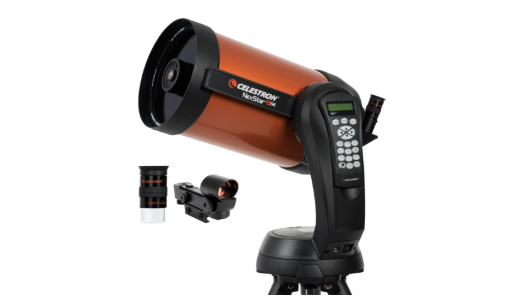
(1) Celestron NexStar 8SE Computerized Telescope

The Celestron NexStar 8SE Computerized Telescope is an excellent option for beginners who want to explore astronomy with powerful optics and automated object tracking. Combining an 8-inch Schmidt-Cassegrain optical system with a computerized GoTo mount, this telescope helps users locate celestial objects without relying entirely on manual navigation. Its iconic orange tube, compact optical design, and upgradeable system make it appealing to newcomers who want a telescope they can continue using as their astronomy skills develop.
The NexStar 8SE features an 8-inch aperture that collects substantial light, helping reveal impressive details across the night sky. Beginners can observe lunar craters, mountain ranges, and surface features, as well as Jupiter’s cloud bands and other planetary details under suitable viewing conditions. Its optics also support observations of deep-sky targets, including galaxies and globular clusters, making it suitable for exploring beyond the Moon and planets.
Despite its large aperture, the Schmidt-Cassegrain design keeps the optical tube relatively compact. This makes the telescope more manageable for transport and storage than some longer telescopes with comparable apertures, although the complete setup still requires careful handling.
One of the main attractions of the Celestron NexStar 8SE is its computerized GoTo mount. The included NexStar+ hand control provides access to a database containing more than 40,000 celestial objects. After alignment, users can select a target, and the mount automatically points the telescope toward it and tracks its movement across the sky.
This automation is particularly helpful for beginners who have not yet learned to recognize constellations or navigate using star charts. It also makes observing sessions more convenient by reducing the time spent searching for individual objects.
Aligning a computerized telescope can seem complicated to first-time users, but Celestron’s SkyAlign technology simplifies the process. Users center three bright stars or planets in the eyepiece, and the system calculates the alignment without requiring them to identify those objects by name.
Accurate alignment is still important, and users must follow the setup instructions carefully. Once completed, however, the system makes it easier to move between celestial targets.
The NexStar 8SE is compatible with a range of Celestron accessories, allowing users to expand their setup with additional automation, wireless control, or location-related features. The purchase includes a two-year warranty and access to technical support. Celestron also advertises a transferable VIP lifetime warranty covering eligible repairs or replacements, subject to its exclusions and terms.
This telescope suits beginners who want computerized assistance without sacrificing optical capability. It is particularly useful for backyard astronomy, family stargazing, lunar and planetary observation, and exploring brighter deep-sky objects. It is also a strong choice for enthusiasts upgrading from a smaller or manually operated telescope. However, its cost, setup requirements, and need for a suitable power source may make it less appealing to buyers seeking a basic, lightweight starter telescope.
Specifications
• Model: Celestron NexStar 8SE • Optical design: Schmidt-Cassegrain • Aperture: 8 inches • Mount: Computerized GoTo • Controller: NexStar+ hand control • Object database: More than 40,000 objects • Alignment system: SkyAlign • Manufacturer warranty: Two-year warranty, with additional VIP lifetime warranty terms advertised by Celestron
Pros
• Large aperture for detailed lunar, planetary, and deep-sky observations.
• Automated GoTo pointing and tracking simplify finding celestial objects.
• SkyAlign reduces the difficulty of initial alignment.
• Compact optical tube relative to its aperture.
• Compatible with accessories for future upgrades.
Cons
• Higher investment than many entry-level telescopes.
(2)Celestron NexStar 102SLT Computerized Telescope
The Celestron NexStar 102SLT Computerized Telescope is a practical choice for beginners who want to explore the night sky without spending hours searching for celestial objects manually. Combining a refractor optical design with computerized navigation and a compact, portable structure, this telescope makes astronomy more approachable for individuals and families.
Its ability to locate and track thousands of astronomical targets, together with beginner-friendly alignment technology, makes it suitable for backyard observations, camping trips, and visits to dark-sky locations.
The NexStar 102SLT uses a refractor optical system designed to deliver clear views of celestial objects. Its aperture gathers light for observing the Moon, planets, and selected deep-sky targets. Beginners can explore lunar craters, Saturn’s rings, and Jupiter’s cloud bands when atmospheric conditions allow. Refractor telescopes are also convenient for terrestrial viewing, making this model useful for observing distant landscapes during the day with the appropriate setup.
This telescope is a good option for users who want to study prominent solar system objects before progressing to more challenging astronomical targets. However, the visibility and level of detail depend on sky conditions, object brightness, and observing technique.
One of the NexStar 102SLT’s main advantages is its computerized object-location system. The telescope provides access to a database containing more than 40,000 celestial objects, including stars, galaxies, and nebulae. After alignment, its motorized mount can automatically point toward selected targets and track their apparent movement across the sky.
This feature is especially helpful for beginners who have not yet learned to identify constellations or use star charts confidently. Instead of spending most of an observing session locating objects, users can concentrate on viewing and learning about them.
Celestron’s SkyAlign system simplifies the alignment process. Users center any three bright celestial objects, such as stars or planets, in the eyepiece, allowing the telescope to calculate its alignment with the night sky. They do not need to know the objects’ names beforehand.
Although careful positioning and following the setup instructions remain important, this technology reduces the difficulty of getting started. Once alignment is complete, users can select objects from the computerized database and begin exploring.
The NexStar 102SLT is designed for convenient transport, making it suitable for camping trips, family outings, and astronomy sessions away from city lights. Its portable construction also helps users store the telescope when it is not in use.
The package includes a free download of Starry Night astronomy software, which provides an interactive simulation of the sky. This resource helps beginners learn about celestial objects and prepare for observing sessions. Celestron also provides a two-year manufacturer warranty and access to technical support.
This telescope is best suited to beginners, families, and students seeking an easy introduction to astronomy. It works well for lunar observation, planetary viewing, educational activities, and casual stargazing while travelling. Experienced observers may also appreciate its portability as a secondary telescope. However, users interested primarily in faint deep-sky objects may prefer a model with a larger aperture.
Specifications
• Model: Celestron NexStar 102SLT
• Optical design: Refractor
• Aperture: 102mm
• Mount: Computerized GoTo
• Object database: More than 40,000 objects
• Alignment technology: SkyAlign
• Included software: Starry Night download
• Warranty: Two-year manufacturer warranty
Pros
• Computerized navigation makes finding objects easier.
• Refractor optics are suitable for lunar and planetary viewing.
• Compact design supports travel and outdoor observing.
• SkyAlign simplifies initial setup.
• Included astronomy software helps beginners learn the night sky.
Cons
• Smaller aperture limits views of faint deep-sky objects compared with larger telescopes.
(3)Gskyer Telescope 70mm Aperture Best Begginers telescope
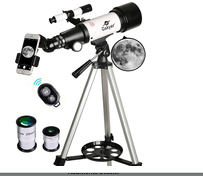
The Gskyer Telescope, 70mm Aperture 400mm AZ Mount Astronomical Refracting Telescope is a beginner-friendly option for anyone interested in exploring the night sky without investing in an expensive astronomy setup.
Designed with portability and ease of use in mind, this refractor telescope combines coated optical glass, interchangeable eyepieces, a smartphone adapter, and an adjustable tripod.
Although it does not offer computerized GoTo navigation, its straightforward manual controls make it a useful starting point for learning how to locate and observe celestial objects.
The Gskyer telescope features a 70mm aperture and a 400mm focal length, giving it an f/5.7 focal ratio. Its fully coated optical glass lenses are designed to improve light transmission and produce clear images. These specifications make the telescope suitable for observing the Moon, prominent lunar craters, and selected bright celestial objects.
The relatively short focal length provides a wider viewing field than many longer-focal-length telescopes, helping beginners locate larger objects in the sky. However, its modest aperture limits the amount of light collected, so faint galaxies and distant nebulae may be difficult to observe in detail.
For the best results, users should choose a location with minimal light pollution and observe under clear atmospheric conditions.
This telescope includes two interchangeable eyepieces and a 3x Barlow lens. The eyepieces offer different magnification options, while the Barlow lens increases the magnifying power of each compatible eyepiece by three times.
This combination gives beginners flexibility when observing objects of different sizes and brightness levels. Lower magnification is generally helpful for locating targets, while higher magnification can reveal additional lunar details when viewing conditions permit.
The package also includes a 5×24 finder scope with a mounting bracket and crosshair markings. This accessory helps users aim the telescope toward a target before viewing it through the main eyepiece, making manual navigation easier.
The included smartphone adapter allows users to position a compatible phone over the eyepiece for basic astronomical photography. A wireless camera remote makes it possible to take pictures without directly touching the phone, helping reduce movement during image capture.
These accessories are useful for beginners who want to photograph the Moon, share observations with friends, or document their first experiences with astronomy.
However, image quality depends on the smartphone, alignment, focus, and viewing conditions. This setup is intended for casual photography rather than advanced long-exposure astrophotography.
The telescope comes with an adjustable aluminum-alloy tripod that supports different viewing positions. Its portable design and included carrying bag make transportation and storage more convenient.
The lightweight setup is suitable for moving between a backyard, campsite, or another observing location. Beginners should still ensure the tripod is stable and securely positioned before observing.
The Gskyer 70mm telescope is best suited to children, families, students, and first-time astronomy enthusiasts who want an affordable introduction to stargazing. It is useful for lunar observation, casual planetary viewing, educational activities, and smartphone photography.
Users seeking automatic object tracking or detailed views of faint deep-sky objects should consider a more advanced telescope.
Specifications
• Optical design: Refractor
• Aperture: 70mm
• Focal length: 400mm
• Focal ratio: f/5.7
• Mount: Manual AZ mount
• Eyepieces: Two interchangeable eyepieces
• Barlow lens: 3x
• Finder scope: 5×24
• Accessories: Smartphone adapter, wireless camera remote, adjustable tripod, and carrying bag
Pros
• Fully coated optics support clear views of bright celestial objects.
• Interchangeable eyepieces provide different magnification options.
• Smartphone adapter and wireless remote support casual photography.
• Adjustable tripod accommodates different viewing positions.
• Carrying bag simplifies transportation and storage.
Cons
• Manual pointing requires users to locate objects themselves.
(4)Celestron NexStar 127SLT Maksutov-Cassegrain Computerized GoTo Telescope
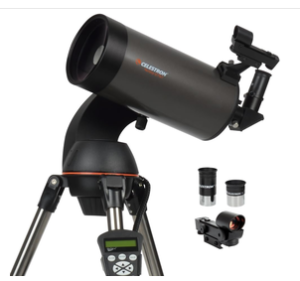
The Celestron NexStar 127SLT Maksutov-Cassegrain Computerized GoTo Telescope is a practical choice for beginners who want to explore the night sky without spending hours searching for celestial objects manually. It combines a 127mm aperture, a computerized GoTo mount, and a compact optical design to make astronomy more accessible.
With automatic object location, tracking capabilities, and beginner-friendly alignment technology, this telescope offers a convenient way to discover planets, the Moon, and selected deep-sky objects.
The NexStar 127SLT uses a 127mm aperture Maksutov-Cassegrain optical system designed to deliver detailed views while keeping the optical tube relatively compact. Its light-gathering ability makes it suitable for observing lunar craters, Saturn’s rings, and Jupiter’s cloud bands under favorable viewing conditions.
Beyond the solar system, users can explore brighter deep-sky targets, including the Orion Nebula. Although results depend on atmospheric conditions and light pollution, the telescope provides an engaging introduction to several areas of astronomy.
Its optical design is particularly useful for planetary observation, making it appealing to beginners who want to study the Moon and planets in greater detail.
One of the telescope’s most useful features is its computerized GoTo system. The NexStar 127SLT provides access to a database containing more than 40,000 celestial objects, including stars, galaxies, and nebulae.
After alignment, users can select an object through the controller, and the motorized mount automatically points toward it. The telescope also tracks the selected target as it moves across the sky because of Earth’s rotation.
This reduces the need for constant manual adjustments and helps beginners spend more time observing rather than searching.
The automated system is especially valuable for users who are still learning constellations and have limited experience navigating the night sky.
Celestron’s SkyAlign technology helps simplify the initial alignment process. Users center three bright celestial objects in the eyepiece, allowing the computerized system to establish its alignment without requiring them to identify the objects by name.
Although proper setup and accurate centering remain important, this approach makes computerized astronomy less intimidating for newcomers. Once aligned, the telescope can locate objects from its database and track them during observation sessions.
The NexStar 127SLT has a compact design that makes it easier to transport between a backyard, campsite, or dark-sky observing location. This portability allows families and astronomy enthusiasts to explore different viewing environments.
The package also includes a download of Starry Night Special Edition software. Users can simulate the night sky, learn about celestial objects, and plan observing sessions before heading outside. Celestron additionally advertises a two-year US manufacturer warranty and access to technical support. Warranty coverage should be confirmed for the buyer’s location.
This telescope suits beginners, families, students, and astronomy enthusiasts who want automated navigation without investing in a large, bulky instrument. It is particularly useful for lunar observation, planetary viewing, educational activities, and exploring brighter deep-sky objects. Experienced observers may also appreciate it as a portable telescope for planetary viewing.
However, users who prioritize faint galaxies or wide-field views of large star clusters may prefer a telescope with a larger aperture or a shorter focal length.
Specifications
• Optical design: Maksutov-Cassegrain
• Aperture: 127mm
• Mount: Computerized GoTo
• Object database: More than 40,000 celestial objects
• Alignment technology: SkyAlign
• Tracking: Motorized automatic tracking
• Included software: Starry Night Special Edition download
• Warranty: Two-year US manufacturer warranty
Pros
• Computerized pointing makes finding celestial objects easier.
• 127mm aperture supports detailed lunar and planetary observations.
• SkyAlign simplifies the alignment process.
• Compact design makes transportation more convenient.
• Included astronomy software supports learning and observation planning.
Cons
• Limited aperture compared with larger telescopes restricts views of faint deep-sky objects.
(5)Celestron StarSense Explorer LT 114AZ Newtonian Telescope
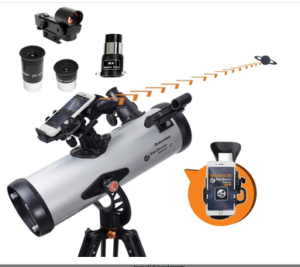
The Celestron StarSense Explorer LT 114AZ Newtonian Smartphone-Guided Telescope is an excellent option for beginners who want an easier way to explore the night sky without investing in an expensive computerized telescope.
It combines a 114mm reflector optical system with smartphone-guided navigation, helping users locate celestial objects using a compatible phone and the StarSense Explorer app. Its straightforward manual mount, guided observing features, and accessible design make it suitable for individuals and families starting their astronomy journey.
The StarSense Explorer LT 114AZ features a 114mm aperture Newtonian reflector with high-reflectivity optical coatings. Its aperture collects light from celestial objects, allowing beginners to observe the Moon’s craters, Jupiter’s prominent features, Saturn’s rings under suitable conditions, and selected deep-sky targets.
The telescope can also reveal brighter objects such as the Orion Nebula and Andromeda Galaxy, particularly when observing from locations with limited light pollution. Its reflector design offers an accessible introduction to astronomical observation without requiring a large optical tube.
For beginners, this combination of aperture and straightforward operation provides opportunities to explore the solar system and brighter objects beyond it.
One of the telescope’s most useful features is its StarSense Explorer technology. Instead of relying entirely on traditional star charts or a computerized GoTo mount, it uses a compatible smartphone to help users navigate the night sky.
After placing the phone in the telescope’s docking system and opening the StarSense Explorer app, users can follow on-screen arrows toward selected celestial objects. The technology analyzes star patterns to determine the phone’s position relative to the night sky and guides the user toward the desired target.
When the app’s aiming indicator turns green, the telescope is positioned to view the selected object through the eyepiece. This approach makes locating celestial targets less intimidating for beginners who have not yet learned to identify constellations.
The StarSense Explorer app provides a list of recommended celestial objects based on the user’s location and observing time. These suggestions help beginners decide what to observe rather than spending time searching for suitable targets.
Users can explore planets, bright nebulae, galaxies, and star clusters, with more objects becoming visible under darker skies. The guided experience also encourages users to learn about astronomy gradually as they discover different targets.
Unlike fully computerized GoTo telescopes, however, the LT 114AZ relies on manual movement. The smartphone provides navigation guidance, but the user must physically point and adjust the telescope.
The telescope features a manual altazimuth mount with an altitude slow-motion adjustment rod. This arrangement helps users make controlled movements when aiming at objects and following the app’s directions.
The relatively simple mounting system makes the telescope approachable for beginners while providing hands-on experience with telescope positioning. Users can gradually develop their observing skills without depending on a fully automated mount.
The Celestron StarSense Explorer LT 114AZ is best suited to beginners, students, and families who want guided stargazing without the expense or complexity of a fully computerized telescope. It works well for backyard astronomy, educational activities, lunar observation, and exploring brighter deep-sky objects. It is particularly useful for smartphone users who appreciate step-by-step guidance.
Specifications
• Optical design: Newtonian reflector
• Aperture: 114mm (4.5 inches)
• Mount: Manual altazimuth
• Navigation: StarSense Explorer smartphone app
• Object guidance: Smartphone-based sky recognition
• Optical coatings: High-reflectivity coatings
• Target objects: Moon, planets, nebulae, galaxies, and star clusters
• Warranty: Two-year US manufacturer warranty
Pros
• Smartphone guidance simplifies finding celestial objects.
• 114mm aperture supports lunar, planetary, and brighter deep-sky observations.
• Recommended sky targets help beginners plan observing sessions.
• Manual controls provide hands-on learning.
• No computerized GoTo motor system is required.
Cons
• Users must move the telescope manually to follow navigation guidance.
Explore more:6 Best 10×42 Binoculars for Begginers
Advantages of Best Computerized Telescope for Beginners
1. Easy Identification and Location of Celestial Objects
One of the biggest advantages of computerized telescopes for beginners is their ability to simplify finding objects in the night sky. Models such as the Celestron NexStar 8SE and NexStar 127SLT feature computerized GoTo systems that automatically point toward selected objects using extensive astronomical databases. Smartphone-guided models, such as the Celestron StarSense Explorer LT 114AZ, use app-based directions to help users locate their targets manually. These technologies reduce the frustration of searching for stars, planets, galaxies, and nebulae, making astronomy more enjoyable for people who are still learning to navigate the night sky.
2. Improved Viewing Through Automatic Tracking
Computerized GoTo telescopes can automatically track celestial objects as they appear to move across the sky because of Earth’s rotation. This feature helps keep planets, stars, and other targets within the field of view without requiring constant manual adjustments. For beginners, automatic tracking makes extended observation sessions more convenient and allows more time to study details through the eyepiece. It is particularly useful when observing the Moon, Jupiter, Saturn, or other objects that can be difficult to keep centered at higher magnifications. However, tracking performance depends on proper alignment and setup.
3. Detailed Views of the Moon, Planets, and Deep-Sky Objects
Many computerized telescopes combine navigation technology with optical systems capable of revealing a variety of celestial objects. For example, the Celestron NexStar 8SE features an 8-inch aperture that gathers substantial light for observing lunar craters, planetary details, star clusters, and selected galaxies. The NexStar 127SLT’s 127mm Maksutov-Cassegrain optics are particularly suitable for lunar and planetary observation, while the NexStar 102SLT offers a portable refractor design. These different optical configurations allow beginners to choose a telescope suited to their interests. Actual viewing quality depends on aperture, atmospheric conditions, sky darkness, and the object being observed.
4. Beginner-Friendly Setup and Learning Opportunities
Computerized telescopes often include alignment systems and guided observing features that make getting started easier. Celestron’s SkyAlign technology, available on models such as the NexStar 8SE, NexStar 127SLT, and NexStar 102SLT, helps users align their telescopes by centering three bright celestial objects. The StarSense Explorer LT 114AZ provides smartphone-guided directions instead. Some models also include astronomy software that simulates the night sky and helps users plan observations. These features reduce the initial learning curve while allowing beginners to develop their knowledge of constellations, planets, stars, and other astronomical objects.
5. Convenient Designs and Opportunities for Future Upgrades
Computerized telescopes are available in different sizes and configurations, allowing beginners to select a model that suits their observing habits and budget. Compact options such as the NexStar 127SLT and NexStar 102SLT are suitable for transporting to campsites, backyards, and darker observing locations. More advanced models, such as the NexStar 8SE, offer compatibility with additional accessories and computer-control options, allowing users to expand their setup as their skills develop. This flexibility makes a computerized telescope a potentially long-lasting investment for people who want to progress from casual stargazing to more advanced astronomical observation.
Factors to Consider When Choosing the Best Computerized Telescope for Beginners
Choosing the best computerized telescope for beginners involves evaluating several features that affect viewing quality, ease of use, and overall value. Whether you want to observe the Moon, explore planets, or discover distant galaxies, understanding these factors will help you select a telescope that matches your interests, experience, and budget.
1. Aperture and Optical Quality
Aperture is one of the most important factors to consider when choosing a computerized telescope because it determines how much light the instrument can collect. A larger aperture generally allows you to see fainter celestial objects and observe more detail, particularly when viewing galaxies, nebulae, and star clusters.
Smaller apertures can still provide satisfying views of the Moon and bright planets, making them suitable for casual stargazing. Optical quality also matters because well-designed optics and effective coatings help produce clearer, brighter images. Beginners should consider their primary observing interests and choose an aperture that balances viewing performance, portability, and affordability.
2. Computerized Mount and Object-Location Technology
The computerized mount determines how easily a telescope can locate celestial objects and, in many models, track them across the sky. GoTo systems use astronomical databases and motorized controls to point the telescope toward selected targets automatically. Smartphone-guided systems offer an alternative by displaying directions that users follow while moving the telescope manually.
Beginners should consider whether they prefer fully automated operation or a more hands-on observing experience. It is also important to check the size of the object database, the accuracy of the navigation system, and whether the telescope can track objects after locating them. Reliable navigation can significantly reduce the time spent searching for targets.
3. Ease of Setup and Alignment
A beginner-friendly telescope should be reasonably straightforward to assemble, align, and operate. Some computerized models use alignment technology that helps determine their position in the night sky after users center several bright stars or planets.
Others rely on smartphone applications to guide the initial pointing process. Before making a purchase, consider how much time and effort setup requires, whether the instructions are easy to follow, and whether additional equipment is needed.
Beginners should also remember that computerized systems may require accurate alignment and a suitable power source to function correctly. Choosing a telescope with a manageable setup process makes it easier to enjoy regular observing sessions.
4. Portability, Size, and Build Quality
Portability is particularly important if you plan to transport your telescope between your backyard, camping sites, and darker locations away from city lights. Compact optical tubes are generally easier to store and carry, while larger telescopes may offer better light-gathering capability but require more space and careful handling.
Consider the combined weight of the optical tube, mount, tripod, and accessories rather than looking at the telescope alone. Build quality is equally important because a stable tripod and secure mount help minimize unwanted movement during observation. A well-constructed, manageable telescope is more convenient to use and can encourage beginners to spend more time exploring the night sky.
5. Included Accessories and Upgrade Options
Accessories can significantly influence a telescope’s usefulness and overall value. Common items include eyepieces, finderscopes, Barlow lenses, tripods, carrying cases, and astronomy software. Different eyepieces provide different magnifications, while a suitable finderscope or navigation application helps locate objects.
Some computerized telescopes also support computer control, wireless connectivity, or additional automation accessories. Beginners should examine what is included in the package and determine whether essential accessories must be purchased separately. It is also worth considering whether the telescope supports future upgrades, allowing you to expand its capabilities as your observing skills and interests develop.
6. Budget, Warranty, and Technical Support
Your budget should cover more than the telescope’s initial purchase price. Depending on the model, you may also need to purchase a power supply, additional eyepieces, protective storage, or other accessories. More expensive telescopes often provide larger apertures, advanced automation, or greater flexibility, but an entry-level model may be sufficient if you mainly want to observe the Moon and bright planets.
Check the manufacturer’s warranty terms, repair arrangements, and availability of technical support before buying. A reliable warranty and accessible assistance can be particularly valuable when learning to operate computerized equipment. The best choice is one that meets your observing needs without creating unnecessary financial pressure.
3 Best Computerized Telescope for Beginners FAQs
1. What Is the Best Computerized Telescope for Beginners?
The best computerized telescope for beginners offers good optical performance, easy alignment, and reliable object-location technology. A telescope with a computerized GoTo mount can automatically locate and track celestial objects, making it easier to explore the night sky without extensive knowledge of astronomy.
Beginners should consider aperture, portability, included accessories, and budget when choosing a model. Telescopes with smartphone-guided navigation are also worth considering for those who want guided assistance without a fully motorized GoTo system.
2. Can Beginners See Planets and Galaxies with a Computerized Telescope?
Yes, beginners can observe planets, galaxies, and other celestial objects with a suitable computerized telescope. Depending on its aperture and optical design, a telescope can reveal lunar craters, Jupiter’s cloud bands, Saturn’s rings, and bright deep-sky objects such as the Orion Nebula. Galaxies and nebulae may appear faint or show limited detail, particularly under light-polluted skies.
For the best results, observe from a dark location when possible, allow the telescope to adjust to outdoor temperatures, and choose clear nights with favorable atmospheric conditions.
3. Are Computerized Telescopes Worth It for Beginners?
Computerized telescopes can be worth the investment for beginners because they simplify locating celestial objects and, in many models, tracking them across the sky. Features such as automatic GoTo navigation, guided alignment, and astronomy software help newcomers spend more time observing and less time searching for targets.
However, computerized models are generally more expensive than basic manual telescopes and may require a suitable power source and additional setup. If you value convenience and want to explore many celestial objects, a computerized telescope can be an excellent choice for developing your astronomy skills.
Final Thoughts
Choosing the best computerized telescope for beginners depends on finding the right balance between optical performance, ease of use, portability, and affordability. Models such as the Celestron NexStar 8SE, NexStar 127SLT, NexStar 102SLT, and StarSense Explorer LT 114AZ offer different advantages for exploring the night sky.
Their light-gathering optics help users observe the Moon, planets, and selected deep-sky objects, while computerized GoTo systems or smartphone-guided navigation make locating celestial targets easier. Features such as automatic tracking, beginner-friendly alignment, astronomy software, and upgrade options further improve the observing experience.
Whether you are introducing your family to astronomy or developing a long-term stargazing hobby, choosing a telescope that matches your interests and budget will help you enjoy clearer, more convenient, and more rewarding nights under the stars.