In this guide to the best smart telescope, I’ll help you discover top-rated options designed to make observing the night sky and capturing stunning
Exploring the wonders of the universe has never been easier, thanks to the latest smart telescopes that combine advanced technology with effortless stargazing. astrophotography images more accessible for beginners and experienced astronomy enthusiasts alike. I’ll explore essential features such as optical quality, camera sensor performance, automated tracking, smartphone connectivity, intelligent image processing, battery life, and portability to help you find the right telescope for your needs.
Whether you want to photograph distant galaxies, explore nebulae, observe the Moon, or enjoy astronomy during outdoor adventures, I’ll review the leading smart telescope options and explain what makes each worth considering. I’ll also provide a practical buying guide covering the most important factors to consider before purchasing, highlight the advantages of smart telescopes, and answer frequently asked questions to help you make an informed decision and choose the best smart telescope for your budget and stargazing goals.
5 Best Smart Telescope
(1)ZWO Seestar S30 Pro Smart Telescope
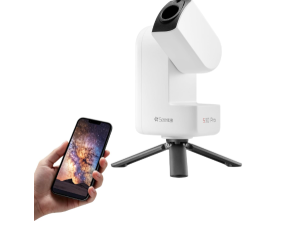
The ZWO Seestar S30 Pro Smart Telescope is designed to make astrophotography easier for beginners and more accessible to experienced astronomy enthusiasts.
Instead of requiring extensive knowledge of telescope alignment, manual tracking, and camera settings, this smart telescope combines automated targeting, intelligent imaging, and smartphone control in a compact device. It is a practical choice for anyone who wants to photograph the night sky without investing in a complicated traditional telescope setup.
The Seestar S30 Pro simplifies stargazing through an app-based control system. Users can power on the telescope, connect their smartphone, and select a celestial object to observe or photograph. Its automatic GoTo targeting and tracking system locates the selected object and follows its movement across the sky, reducing the need for manual adjustments.
Images can be viewed and captured directly through a compatible smartphone. This makes the telescope particularly appealing to beginners who want to explore astronomy without spending hours learning complicated equipment controls. For the best deep-sky results, the telescope should remain stationary during imaging to maintain accurate tracking.
Optical quality is important when photographing faint celestial objects. The Seestar S30 Pro uses apochromatic optics designed to reduce color fringing and improve contrast, helping stars and other astronomical subjects appear sharper. This is especially useful when capturing detailed images of distant objects against a dark background.
Built-in light pollution filters also help improve astrophotography in urban and suburban environments. Although these filters cannot eliminate all the effects of artificial lighting, they can make observing and photographing selected celestial targets more practical when traveling to a remote dark-sky location is inconvenient.
The dual-camera imaging system is designed to capture detailed astronomical photographs and wider night-sky scenes. Its advertised 4K-quality imaging makes it suitable for photographing star fields, nebulae, galaxies, and other deep-sky subjects, as well as landscape compositions featuring the night sky.
Intelligent imaging modes reduce the technical work involved in capturing photographs. AI-assisted noise reduction helps produce cleaner images, while sky and foreground separation supports more balanced night landscapes. Automatic mosaic stitching also makes it easier to create wider compositions without manually combining multiple photographs.
Weighing approximately 3.64 pounds, the Seestar S30 Pro is easy to transport on camping trips, holidays, and outdoor adventures. Its compact construction also makes storage more convenient than with many traditional telescope systems.
The telescope supports imaging of the Moon and Sun, as well as deep-sky targets and wide-field night landscapes. Solar observation requires an appropriate solar filter and compliance with the manufacturer’s safety instructions. Despite its versatility, this model is primarily intended for deep-sky imaging rather than detailed planetary observation.
Anti-dew protection and support for extended imaging sessions further improve its suitability for overnight astronomy.
Specifications
• Model: ZWO Seestar S30 Pro
• Product type: Smart telescope
• Weight: Approximately 3.64 lb
• Optics: Apochromatic optical system
• Imaging system: Dual-camera imaging
• Image quality: Advertised 4K-quality imaging
• Control: Smartphone app
• Tracking: Automatic GoTo targeting and tracking
• Additional features: AI noise reduction, light pollution filters, automatic mosaic stitching, anti-dew protection
Pros
• Beginner-friendly operation: Automated targeting and smartphone controls simplify astrophotography.
• Improved image processing: AI noise reduction helps produce cleaner astronomical images.
• Urban imaging support: Built-in filters help when observing under light-polluted skies.
• Portable construction: The lightweight design is convenient for travel and camping.
• Multiple imaging options: Suitable for deep-sky objects, the Moon, the Sun with appropriate protection, and night landscapes.
Cons
• Dependence on software: Users need a compatible smartphone and app to access its smart features.
(2)DWARF Mini Smart Telescope Review
The DWARF Mini Smart Telescope is a compact digital telescope designed to make astronomy and astrophotography accessible to beginners, travelers, and curious skywatchers. Weighing just 1.85 pounds, it offers a portable alternative to traditional telescope setups, allowing users to explore celestial objects without carrying bulky equipment.
Its automated tracking, smartphone app control, and cloud-based image processing help simplify the process of capturing astronomical photographs, making it an appealing option for anyone interested in discovering the night sky.
Portability is one of the DWARF Mini’s main advantages. At approximately 840 grams, it can fit into a backpack or a sufficiently large pocket, making it convenient for hiking, camping, and trips to locations with darker skies. Its all-in-one construction reduces the need to transport multiple separate components, allowing users to set up an astronomy session with less preparation.
This compact design is particularly useful for people who enjoy outdoor adventures and want to photograph stars during their travels. It is also suitable for casual observing sessions at home when a full-sized telescope would be inconvenient.
The DWARF Mini works with the DWARFLAB app, which includes an interactive star map to help users navigate the sky. Rather than manually searching for celestial objects, users can select a target through the app and let the telescope handle the positioning process.
Automatic GoTo targeting and tracking make the experience more approachable for beginners who may not know how to locate nebulae, star clusters, and other astronomical subjects. The manufacturer advertises a setup process of approximately three minutes, although actual setup time can vary depending on conditions and familiarity with the app.
The telescope features a Sony IMX662 sensor with a 1/2.8-inch format and 2.9-micrometer pixels. This sensor is designed to capture astronomical details while helping control image noise, which is valuable when photographing faint objects against a dark background.
Its automated tracking system supports a full 360-degree pivot, providing flexibility when selecting and following targets. This reduces the amount of manual adjustment required during an observing session and helps users concentrate on choosing objects and capturing images.
For users interested in more advanced astrophotography, the DWARF Mini includes an Equatorial (EQ) mode and supports single-frame exposures of up to 90 seconds. Longer exposures can collect more light from faint celestial objects, helping reveal details that may not be visible in shorter captures. However, results depend on tracking accuracy, sky conditions, and the selected target.
Built-in light pollution filters can also help improve selected deep-sky images in urban environments. These filters do not eliminate all interference from artificial lighting, but they can make astrophotography more practical when traveling to dark-sky locations is not possible.
Integrated cloud processing helps refine captured data without requiring users to master complicated editing software immediately. This feature makes the telescope appealing to families, children with adult supervision, and beginners who want to create and share astronomy photographs. Users should check the app’s connectivity requirements and any applicable processing limitations before purchasing.
Specifications
• Model: DWARF Mini Smart Telescope
• Weight: 1.85 lb (840 g)
• Sensor: Sony IMX662
• Sensor format: 1/2.8 inch
• Pixel size: 2.9 μm
• Control system: DWARFLAB smartphone app
• Tracking: Automatic GoTo with 360-degree pivot
• Maximum single-frame exposure: 90 seconds
• Additional features: EQ mode, light pollution filters, cloud image processing
Pros
• Highly portable: Lightweight construction suits travel and outdoor adventures.
• Easy navigation: The app-based sky atlas helps beginners locate celestial targets.
• Automated tracking: Reduces the need for manual positioning.
• Advanced imaging options: EQ mode and long exposures support deep-sky photography.
• Simplified editing: Cloud processing helps improve images without advanced editing skills.
Cons
• Variable imaging results: Light pollution, weather, and tracking conditions affect photographs.
(3)Dwarf 3mart Telescope

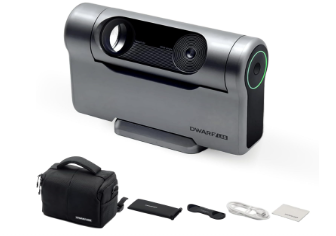
The Dwarf 3 Smart Telescope is a compact, versatile imaging device designed for people who want to explore astronomy, photograph wildlife, and capture outdoor landscapes without carrying bulky equipment. Weighing just 3 pounds, it combines automated tracking, a dual-lens imaging system, and app-based image processing in a travel-friendly package.
Its beginner-oriented controls make it an appealing option for newcomers to astrophotography, while its flexible imaging capabilities also offer value to experienced hobbyists seeking a portable setup.
Portability is one of the Dwarf 3’s biggest advantages. Weighing approximately 1.35 kg, it is easy to carry in a standard backpack, making it suitable for camping, hiking, road trips, and visits to dark-sky locations. Its compact construction also makes storage convenient for people who want astronomy equipment without dedicating much space at home.
The telescope comes with a carrying bag, helping users transport and organize the device between observing locations. This design is particularly useful for travelers who want to photograph the night sky while exploring new destinations.
The Dwarf 3 features a dual-lens design intended to support different types of photography. Its telephoto lens is suited to distant subjects, including wildlife, landscapes, and deep-sky objects. The wide-angle lens is designed for broader scenes, such as the Milky Way, star trails, and night landscapes.
This versatility makes the device more than a dedicated astronomy telescope. During daylight, users can explore wildlife and distant scenery, while nighttime sessions can focus on celestial photography. The wide-angle camera can also help users identify targets and frame scenes before capturing images.
The Dwarf 3 offers automated tracking to help follow selected celestial objects and moving subjects. Instead of manually adjusting the device throughout a session, users can rely on its smart functions to simplify target tracking.
Its advertised 4K imaging capability supports detailed image capture, depending on the selected camera, shooting mode, and subject. Automated operation is especially helpful when photographing the night sky, where accurate positioning and consistent tracking can influence the final results.
Although the device can be used to photograph planets, it should not be assumed to provide the same detailed planetary views as a telescope specifically designed for high-magnification planetary observation.
The dedicated DWARFLAB app includes cloud-powered processing tools that help enhance captured photographs. Users can apply image processing without needing a computer or advanced editing software, making the workflow more accessible to beginners.
This approach is useful for people who want to capture and improve astronomical photographs before sharing them with friends or on social media. However, cloud processing may depend on internet access, app compatibility, and the available processing options.
The Dwarf 3 is designed to make setup and operation straightforward, with the manufacturer advertising a startup process of approximately two minutes. Automatic functions and app-based controls reduce the learning curve for users who have never operated a smart telescope.
The package includes a carrying bag, magnetic filters, a filter pouch, a cleaning cloth, and a USB-C cable. These accessories help with transport, basic care, and filter storage.
Specifications
• Model: Dwarf 3 Smart Telescope
• Weight: 3 lb (1.35 kg)
• Imaging system: Dual-lens design
• Imaging capability: Advertised 4K imaging
• Control system: DWARFLAB smartphone app
• Tracking: Automated tracking
• Connectivity and charging: USB-C cable included
• Included accessories: Carrying bag, magnetic filters, filter pouch, cleaning cloth
Pros
• Highly portable: Lightweight construction suits travel, hiking, and camping.
• Versatile imaging: Supports astronomy, wildlife photography, and landscape capture.
• Automated tracking: Reduces manual adjustments during imaging sessions.
• Convenient processing: App-based cloud tools simplify photo enhancement.
• Beginner-friendly operation: Automatic features make getting started easier.
Cons
• App dependence: Many smart functions require a compatible smartphone.
(4)Vaonis Vespera Pro Smart Telescope
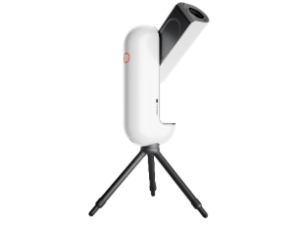
The Vaonis Vespera Pro Smart Telescope is a premium observation station designed for astronomy enthusiasts who want to capture detailed images of the night sky with minimal manual setup. Combining a highly sensitive Sony imaging sensor, specialized optical technology, panoramic capture capabilities, and automated image calibration, it offers a modern approach to astrophotography.
Its app-based controls and advanced imaging features make it appealing to experienced hobbyists while providing an accessible entry point for beginners who are willing to invest in a more sophisticated smart telescope.
One of the main features of the Vespera Pro is its Sony IMX676 STARVIS 2 sensor. This imaging sensor is designed for high sensitivity, helping the telescope collect useful image information from relatively faint astronomical targets. This is particularly important when photographing galaxies, nebulae, and star clusters, where capturing subtle details can be challenging.
The sensor is intended to support detailed astronomical images with improved light sensitivity. Actual results will depend on factors such as sky darkness, atmospheric conditions, exposure time, and the selected target. For astrophotographers who want to explore deep-sky objects, the sensor provides a capable foundation for collecting and processing celestial images.
The Vespera Pro incorporates CovalENS, Vaonis’s proprietary panoramic imaging technology. This feature allows users to capture wider areas of the sky by combining observations across multiple image sections.
Panoramic imaging is useful when photographing large celestial regions that do not fit comfortably within a single field of view. It can help users create expansive compositions of nebulae, star fields, and other astronomical subjects. Rather than manually assembling separate photographs using external editing software, users can take advantage of the telescope’s integrated imaging workflow.
This feature is particularly attractive to astrophotographers who enjoy creating wide-field images and documenting larger sections of the night sky.
A larger imaging sensor requires an optical system capable of delivering good image quality across the sensor’s surface. Vaonis has developed a dedicated field corrector for the Vespera Pro to help make effective use of the sensor and maintain image quality across the captured field.
This optical design is intended to improve the consistency of astronomical images, including toward the edges of the frame. For users photographing extended deep-sky objects or creating panoramic compositions, effective field correction can help produce more uniform results.
The Vespera Pro provides access to Expert Mode through the Singularity app. This gives users additional control over their observing and imaging sessions compared with a more simplified, fully automatic workflow.
Expert Mode is useful for enthusiasts who want to explore more advanced imaging options as their skills develop. Beginners can start with a straightforward app-based experience, then investigate additional settings when they become more comfortable with astrophotography.
The smartphone-based interface also makes it convenient to manage observing sessions without needing the complicated controls associated with some traditional telescope systems.
Image noise can affect astrophotographs, especially during longer exposures and when photographing faint objects. The Vespera Pro automatically subtracts calibration frames from observations to help correct certain sensor-related artifacts.
This automated dark calibration reduces the need for users to manage calibration manually. It is particularly beneficial for those who want to focus on capturing celestial objects rather than spending extensive time processing raw images.
Specifications
• Model: Vaonis Vespera Pro Smart Telescope
• Sensor: Sony IMX676 STARVIS 2
• Imaging technology: CovalENS panoramic capture
• Optical system: Premium optics with dedicated field corrector
• Software: Singularity app
• Advanced controls: Expert Mode
• Calibration: Automatic dark-frame subtraction
Pros
• Sensitive imaging sensor: Designed to capture detailed astronomical images, including faint deep-sky subjects.
• Panoramic photography: CovalENS supports wider compositions of the night sky.
• Optimized optical design: Field correction helps maintain image quality across the sensor.
• Advanced app controls: Expert Mode provides additional flexibility for experienced users.
• Simplified calibration: Automatic dark-frame subtraction reduces manual processing tasks.
Cons
• App dependence: Operating and controlling the telescope relies on the compatible software.
(5)4K Digital Electronic Astrophotography Telescope with 3-Inch Flip Screen
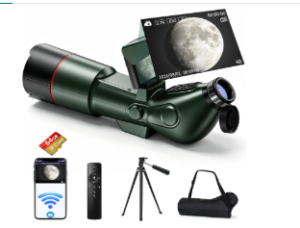
The 4K Digital Electronic Astrophotography Telescope with a 3-inch Flip Screen is designed for users who want to explore the night sky while capturing photos and videos with minimal equipment. Combining an electronic eyepiece, a flip-out display, smartphone connectivity, and wireless remote control, it offers a convenient alternative to traditional telescope setups. Its beginner-oriented design makes it appealing to families, casual astronomy enthusiasts, and aspiring astrophotographers who want to photograph celestial objects and share their discoveries.
One of the telescope’s main attractions is its 3-inch flip-out screen, which allows users to view their subjects without needing to look continuously through a conventional eyepiece. The built-in electronic eyepiece provides another viewing option, giving users flexibility during observing sessions.
The external display is particularly useful when sharing views of the Moon, stars, and other visible celestial objects with friends or family. A foldable sunshade helps reduce glare on the screen, making it easier to view in brighter surroundings. This combination makes the telescope suitable for group stargazing and educational activities.
The telescope supports app-based control, allowing users to view live images, transfer photographs, and record videos on a compatible smartphone. This feature simplifies the process of saving astronomical observations and sharing them on social media.
For beginners, the ability to manage images through a phone reduces the need for separate imaging equipment. However, users should check the app’s compatibility with their device before purchasing, as available features may vary.
A wireless remote provides control from a distance of up to 85 feet under suitable conditions. Users can change operating modes, capture photographs, and start video recordings without touching the telescope directly.
This is useful during extended observing sessions, especially when photographing meteor showers or recording night-sky scenes. Remote operation can also help minimize unwanted movement caused by pressing buttons on the telescope itself.
The telescope features a 78mm aperture and a manual focus ring that allows users to adjust sharpness according to their target. This tactile control may appeal to people who enjoy learning the practical aspects of astronomy rather than relying entirely on automation.
Its electronic eyepiece includes plus-or-minus 6 diopter adjustment to accommodate different eyesight needs. Although the manual focusing system offers control, beginners may need practice to obtain sharp images consistently.
The manufacturer advertises 4K video recording and 30MP photographs, allowing users to capture and store images of the Moon, planets, and star fields. Results will depend on the target, sensor performance, optical quality, and observing conditions.
The telescope should not automatically be assumed to deliver the same deep-sky performance as specialist smart telescopes with dedicated tracking and image-stacking systems.
A 64GB memory card is included, with support for cards up to 512GB according to the supplied specifications. This provides room for storing photographs and video clips during astronomy sessions.
Specifications
• Product type: Digital electronic telescope
• Aperture: 78mm
• Display: 3-inch flip-out screen
• Video recording: Advertised 4K
• Photo resolution: Advertised 30MP
• Focusing: Manual focus ring
• Remote control range: Up to 85 feet
• Storage: 64GB card included; supports up to 512GB
Pros
• Convenient viewing: Flip screen and electronic eyepiece offer flexible viewing options.
• Easy image sharing: Smartphone connectivity simplifies transferring photographs and videos.
• Wireless operation: Remote control helps capture images without touching the telescope.
• Manual focus control: Allows users to fine-tune image sharpness.
• Included storage: The supplied memory card helps users begin recording immediately.
Cons
• Screen visibility varies: Bright surroundings can still make display viewing challenging.
Advantages of the Best Smart Telescope
1. Easy to Use for Beginners
One of the biggest advantages of the best smart telescopes is their ease of use. Unlike traditional telescopes that may require manual alignment, complicated adjustments, and knowledge of star charts, many smart telescopes feature automated targeting, tracking, and smartphone app controls.
Models such as the ZWO Seestar S30 Pro, DWARF 3, and UNISTELLAR Odyssey PRO help users locate celestial objects with less effort. These features make astronomy more accessible to beginners, families, and anyone who wants to explore the night sky without spending hours learning complicated equipment setup.
2. Advanced Astrophotography Capabilities
Smart telescopes make it easier to capture photographs of celestial objects, including stars, nebulae, galaxies, and the Moon. Many models combine digital imaging sensors, automated tracking, and image-processing software to improve the quality of captured photographs.
For example, the Vaonis Vespera Pro offers a sensitive Sony STARVIS 2 sensor and panoramic imaging technology, while the ZWO Seestar S30 Pro provides AI-assisted noise reduction and automatic mosaic stitching. These features help users capture and enhance astronomical images without necessarily needing a separate camera, advanced editing software, or extensive photography experience.
3. Convenient Smartphone Control and Image Sharing
Another important advantage is the ability to control the telescope and manage images through a compatible smartphone or tablet. Many smart telescopes use dedicated applications that allow users to select targets, monitor observations, capture photographs, and transfer images. Some models also provide digital eyepieces or built-in screens for convenient viewing. This functionality makes it easier to share astronomical discoveries with friends and family, save photographs for later, and introduce children to astronomy through interactive activities. Smartphone integration also reduces the need for additional imaging accessories.
4. Portable and Versatile Designs
Many smart telescopes are designed to be compact and lightweight, making them convenient for travel, camping, hiking, and outdoor observation. For example, the DWARF Mini weighs approximately 1.85 pounds, while the DWARF 3 weighs around 3 pounds.
Their portable construction makes it easier to transport astronomy equipment to locations with darker skies, where observing conditions may be more favorable. Certain models also support additional uses, such as landscape imaging and wildlife photography. This versatility makes smart telescopes attractive to travelers and outdoor enthusiasts who want to explore different subjects with one compact device.
5. Automated Tracking and Intelligent Image Processing
Smart telescopes reduce the amount of manual work involved in locating, following, and photographing celestial objects. Automated GoTo systems can direct the telescope toward selected targets, while tracking systems help keep those objects positioned during observations.
Some models also include intelligent processing features that reduce image noise, apply calibration corrections, or combine multiple images to reveal more detail. For instance, the DWARF 3 offers cloud-based image processing, while the Vaonis Vespera Pro automatically subtracts calibration frames.
These capabilities simplify the imaging process, helping beginners achieve more useful results while allowing experienced astronomy enthusiasts to spend more time exploring the universe.
Factors to Consider When Choosing the Best Smart Telescope
1. Optical Quality and Aperture
Optical quality and aperture are important factors when choosing a smart telescope because they influence how much light the device collects and how clearly celestial objects can be observed.
A larger aperture generally gathers more light, which can help reveal faint stars, nebulae, and galaxies. The quality of the lenses and optical coatings also affects sharpness, contrast, and color accuracy. If you are interested in deep-sky astrophotography, look for a telescope with suitable optics and good light-gathering capabilities.
For casual stargazing and viewing brighter objects, a more compact optical system may be sufficient. Consider your observing goals before deciding which specifications matter most.
2. Imaging Quality and Camera Sensor
The imaging system determines how effectively a smart telescope captures photographs and videos of celestial objects. Important features include sensor size, pixel characteristics, resolution, and low-light sensitivity.
A sensitive sensor can help capture faint astronomical details, while effective image processing can reduce noise and improve the appearance of the final photograph. However, a high megapixel count or advertised 4K video resolution does not automatically guarantee superior astrophotography.
Optical quality, exposure settings, tracking accuracy, and software all contribute to the final result. Choose an imaging system that matches your intended use, whether that involves photographing the Moon, capturing star fields, or exploring distant galaxies.
3. Automated Tracking and Ease of Operation
Smart telescopes are designed to simplify astronomy through features such as automatic target recognition, computerized positioning, and motorized tracking.
These functions help users locate celestial objects and follow them as the Earth rotates, reducing the need for constant manual adjustments. Beginners should look for intuitive controls, clear instructions, and an easy-to-use smartphone application.
More experienced users may prefer additional manual settings and advanced imaging options. It is also worth checking whether the telescope requires alignment procedures or a stable mounting surface before observations begin. Choosing a system that matches your experience level can make stargazing more enjoyable and reduce frustration during setup.
4. Portability and Build Quality
Portability matters if you plan to take your telescope camping, hiking, traveling, or to dark-sky locations away from home. Lightweight, compact designs are easier to carry and store, while a protective carrying case can simplify transportation.
However, you should also consider durability, mounting stability, and resistance to environmental conditions such as moisture and dew. A lightweight telescope may be convenient, but it still needs a stable surface for accurate tracking and clear images. Check the combined weight of the telescope, tripod, and accessories rather than looking at the device alone. The best choice balances portability with reliable construction and practical usability.
5. Battery Life, Connectivity, and Storage
A smart telescope depends on its power supply, software, and storage options to support successful observing sessions. Battery life is particularly important for users who plan to photograph the night sky for several hours.
Consider whether the battery is rechargeable, how long it typically lasts, and whether external power is supported. Smartphone compatibility is equally important because many telescopes rely on dedicated applications for control, target selection, and image viewing.
Check the supported operating systems and whether essential functions require an internet connection. Finally, examine the available storage options, including built-in memory, memory card support, and image-transfer methods, to ensure the telescope suits your photography habits.
6. Image Processing Features and Overall Value
Image processing can significantly influence the quality and convenience of astrophotography. Features such as noise reduction, automatic calibration, image stacking, panoramic stitching, and cloud-based enhancement can help reveal details that are difficult to capture in a single photograph.
These tools are particularly useful for beginners who do not have experience with specialist editing software. Before purchasing, check which processing features are included, whether cloud services require internet access, and whether additional subscriptions or fees apply.
You should also compare the total price with the telescope’s optical performance, tracking capabilities, accessories, warranty terms, and software support. Choosing a model that provides the features you will actually use offers better long-term value than paying extra for specifications you may never need.
3 Best Smart Telescope FAQs
1. What is a smart telescope, and how does it work?
A smart telescope is a modern astronomical device that combines optical components, digital imaging sensors, automated tracking, and software to simplify stargazing and astrophotography. Many models connect to a smartphone or tablet, allowing users to select celestial objects, control observations, and capture images through a dedicated application.
Depending on the model, features may include automatic target recognition, image stacking, noise reduction, and panoramic imaging. These functions make it easier for beginners and experienced astronomy enthusiasts to explore the night sky without relying entirely on manual adjustments.
2. Can a smart telescope photograph galaxies, nebulae, and planets?
Yes, many smart telescopes can photograph galaxies, nebulae, star clusters, and other deep-sky objects, provided the equipment and observing conditions are suitable. Automated tracking and digital image processing can help reveal faint details that may be difficult to capture with basic equipment. Some models can also photograph the Moon and planets, but performance varies considerably.
Telescopes designed primarily for deep-sky imaging may not provide detailed planetary photographs. Before purchasing, consider the telescope’s aperture, sensor quality, tracking capabilities, and intended imaging applications to ensure it matches your astronomical interests.
3. Are smart telescopes suitable for beginners?
Yes, smart telescopes are generally well suited to beginners because they automate many tasks involved in traditional astronomy. Features such as smartphone controls, automatic target selection, motorized tracking, and image enhancement reduce the learning curve and make observing more convenient.
Lightweight designs also make some models easy to transport for camping trips and outdoor stargazing. However, beginners should still consider battery life, app compatibility, setup requirements, and the telescope’s imaging capabilities. Choosing a model with intuitive controls and clear instructions can provide an enjoyable introduction to astronomy while leaving room to develop more advanced astrophotography skills.
Final Thoughts
Choosing the best smart telescope depends on your observing goals, budget, and experience level, but the top options offer an impressive combination of advanced imaging technology, automated tracking, and user-friendly controls.
These telescopes make exploring the night sky easier by helping users locate celestial objects, capture detailed astronomical photographs, and enhance images through intelligent processing. Features such as smartphone connectivity, portable designs, sensitive imaging sensors, and automatic target recognition make them suitable for beginners, experienced astronomy enthusiasts, and outdoor adventurers alike.
Whether you want to photograph distant galaxies and nebulae, observe the Moon, or capture beautiful night-sky landscapes, the right smart telescope can provide a convenient and rewarding experience. By comparing optical quality, imaging performance, battery life, portability, and software capabilities, you can select a model that meets your needs and helps you discover the wonders of the universe with greater confidence.